
We cannot ignore the fact that, in India, there are over 101 million people who have diabetes. Moreover, about 1 in 4 adults has high blood pressure. Post-COVID, the concept of a “multivitamin” has become essential in households.
Whereas, in the U.S., nearly 7 in 10 adults, roughly 66% to 68% of all adults, take at least one prescription medication. This indicates that medical expenses are highly dominating the people worldwide.
So many people ask, Will they have a solution for saving up on their healthcare spending? Yes, absolutely. One of the most important generic medicines benefits is that they help people save significantly on medical expenses. Also, they offer the same quality and effectiveness as brand-name drugs at a much lower cost.
Shall we continue with this in more detail?
Benefits of Generic Medicines
Generic medicines offer multiple benefits for patients, healthcare systems, and payers:
- Lower costs: Generics are significantly cheaper than brand-name drugs, allowing more patients to access essential treatments.
- High quality: Approved generics are clinically equivalent to branded medicines, ensuring safety and effectiveness.
- Wider availability: Generic manufacturers can produce medicines in high volumes, helping ensure a steady supply even during health crises like COVID-19.
- Support for innovation: By reducing overall healthcare spending, generics create financial space for new, innovative treatments to be adopted more widely.
How Do Generic Medicines Make Healthcare More Affordable for Everyone?
Generic medicines reduce healthcare costs by replacing expensive brand-name drugs with equally effective, lower-cost alternatives. For example, generics now make up about 90% of all prescriptions in the U.S., helping payers and insurance programs save billions.
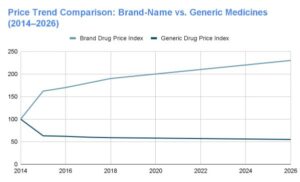
Historical data show how this works in practice. Between 2014 and 2015, the average price of commonly used brand drugs increased by 62.1%, while prices for generic medicines declined by 36.9%. By controlling costs, generics ensure that patients pay less for their prescriptions and that payers can afford broader healthcare coverage.
This historical and projected data show that brand-name drug prices have risen sharply, while generic medicine prices have declined and stabilized, highlighting the ongoing affordability advantage of generics through 2026.
Brand vs. Generic Medicines: A Side-by-Side Comparison
This comparison clearly shows why generics play a vital role in affordable healthcare systems.
| Feature | Brand-Name Medicines | Generic Medicines |
| Price | High and often increasing | Significantly lower |
| Active Ingredients | Original patented formula | Same active ingredients |
| Effectiveness | Clinically tested | Clinically equivalent |
| Market Share | Around 10% of prescriptions | Around 90% of prescriptions |
| Historical Price Trend | Significant price increases | Price reductions and long-term stability |
| Accessibility | Limited by cost | More widely accessible |
| Role in Healthcare | Innovation-focused | Cost-saving and access-focused |
What Role Do Generic Manufacturers Play in Expanding Global Healthcare Access?
Generic manufacturers do more than lower drug costs; they actively ensure medicines reach the patients who need them most, especially in low- and middle-income countries (LMICs). They do this by:
- Building partnerships with governments, procurement agencies, and global health organizations.
- Overcoming regulatory hurdles and improving drug registration processes.
- Investing in local manufacturing to maintain a continuous supply.
- Understanding local demand to better align production with patient needs.
- Licensing products to increase access to newer treatments.
During COVID-19, generic manufacturers also demonstrated their importance by keeping essential medicines and treatments available worldwide despite disruptions in global supply chains.
Challenges in the Generic Drug Market
While generics are essential, there are hurdles:
- Lower profits: Declining prices can reduce incentives for manufacturers, especially for drugs not sold in high volumes.
- Supply shortages: Limited production facilities and regulatory investment needs can lead to drug shortages.
- Price manipulation: Single-source drugs have sometimes been subject to extreme price hikes by profiteers, as seen in the Daraprim case.
Efforts like predictive supply algorithms, global production strategies, and regulatory incentives help mitigate these challenges, ensuring that generics remain available and affordable.
Future of Generic Medicines
The future of generics includes specialty oral solid drugs and biosimilars, which are equivalent alternatives to complex biologic treatments. With patents expiring for many high-cost drugs, generics can provide massive cost savings:
- Biosimilars could reduce spending on biologic drugs by $54 billion over the next decade.
- New generic approvals represent billions in potential savings in the U.S., enabling health systems to fund innovative treatments like gene therapies.
- The combined growth of generics and biosimilars will help control healthcare costs, expand patient access, and make healthcare more equitable worldwide.
Verdict
This means that generic medicines can play a long-term role in healthcare because they are affordable, fair, and sustainable. By reducing costs, improving access, and supporting innovation, they are not just alternatives; they are essential for global health. As more generics and biosimilars become available, healthcare systems can offer life-saving treatments to more patients, anywhere in the world.
Frequently Asked Questions
Are generic medicines as safe as brand-name drugs?
Yes. Generic medicines contain the same active ingredients and must meet the same safety, quality, and effectiveness standards as brand-name drugs.
Why are generic medicines cheaper?
Generic medicines are cheaper because manufacturers do not have to repeat expensive research and development or marketing costs. They can produce medicines at lower prices once patents expire.
Do generic medicines work the same way as branded medicines?
Yes. Generics are clinically equivalent to brand-name drugs and provide the same therapeutic benefits.
How do generic medicines help healthcare systems?
Generics reduce overall drug spending, allowing governments and insurers to provide treatment to more people and invest in new medical innovations.
What are biosimilars, and why are they important?
Biosimilars are lower-cost alternatives to complex biologic medicines. They help reduce spending on expensive treatments and improve access to care for patients with chronic or rare diseases.
Copyright: All rights reserved. Unauthorized reproduction or distribution of any content on this site is prohibited. For permissions, please contact https://vopharma.in.